
2-3 years
Wake between 6:30-7:30am · 1-2 hour nap in the early afternoon · dinner by 6:30pm · bedtime ritual at 7:30pm · asleep between 8-8:30pm. Total: 11-14 hours of sleep a day.
Building a kids' routine that works comes down to three moves: set fixed times for the day's "pillars" (wake-up, meals, bath and sleep), make the routine visible to your child with an illustrated chart, and stay consistent for at least two weeks before adjusting. It sounds simple — and it is — but the difference between a routine on paper and a routine your child actually follows is in the details.
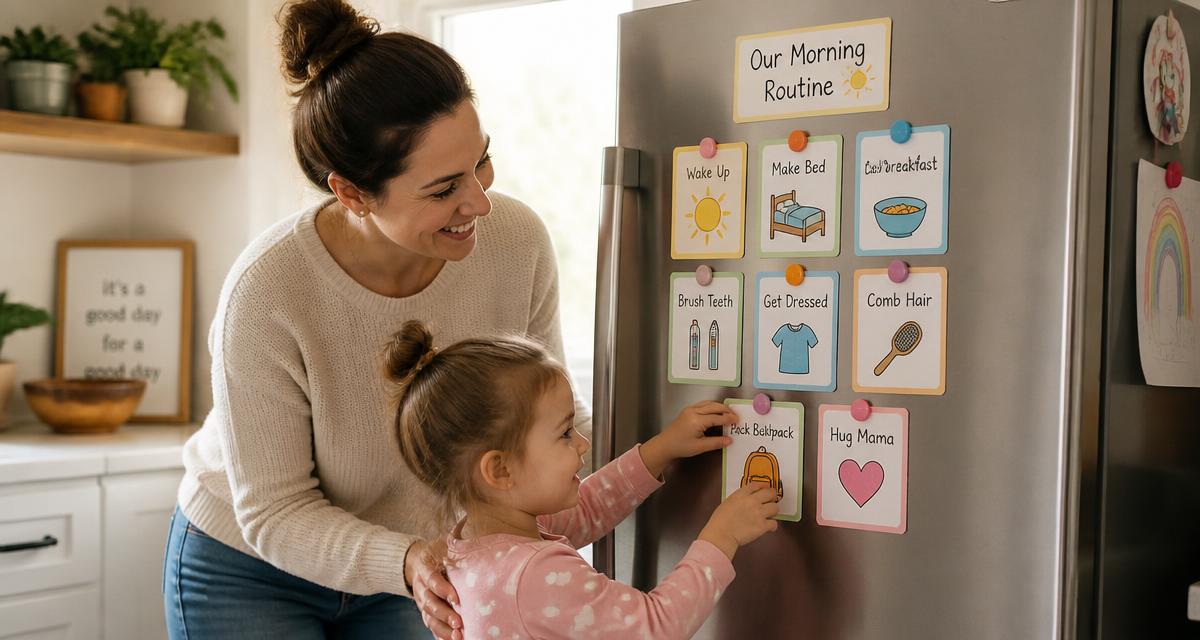
Young children have no clear sense of time. They don't know whether the bath comes before or after dinner, or when playtime will end — and a lot of meltdowns are born from that unpredictability. When the day follows a familiar sequence, a child can anticipate what's next, and anticipation creates safety.
Important: a routine isn't military rigidity. It's a predictable structure with room for flexibility. The order of events matters more than the exact clock time.
A consistent routine helps you:
Every family is different, but these ranges work as a reference:
Wake between 6:30-7:30am · 1-2 hour nap in the early afternoon · dinner by 6:30pm · bedtime ritual at 7:30pm · asleep between 8-8:30pm. Total: 11-14 hours of sleep a day.
Wake between 6:30-7:30am · optional nap (many kids drop it at this stage) · dinner by 7pm · asleep between 8-8:45pm. Total: 10-13 hours.
Wake between 6:30-7:30am · no nap · homework before dinner · asleep between 8:30-9pm. Total: 9-12 hours.
From the skeleton of the day to a routine that runs itself:
First set the four non-negotiable times: wake-up, meals, bath and bed. They're the backbone of the day — everything else (play, school, screens, homework) fits between them.
From age 2-3 on, they can (and should) take part. Ask "what comes after dinner?" and let them help order the steps. An imposed routine creates resistance; a co-built routine creates buy-in.
This is the step most people skip, and the one that makes the biggest difference. A chart at your child's eye level, with a drawing for each step (sun for waking, plate for lunch, moon for bed). When they ask "what's next?", the chart answers instead of you.
The hardest moments of the day are transitions. A 5-minute warning, one specific song for tidying up, the same three steps before bed (bath → story → goodnight kiss). Their brain learns: when that song plays, playtime is ending.
Every new routine meets resistance in the first days — that's expected, not proof it "doesn't work". Keep the structure for 10 to 14 days, then adjust only what clearly doesn't fit your family.
A few adjustments solve most of the pushback:
The step isn't negotiable, but the "how" can be: "bath is now — do you want toys or bubbles?". Your child feels control without breaking the routine.
A timer to tidy up "before the rocket launches", a race to the bathroom, missions of the day. Play works especially well for kids who freeze at transitions.
"You put the blocks away all by yourself!" works better than promising a reward at every step. A chore chart with stickers gives that feedback in a concrete way.
If one part of the day has to slip, don't let it be the night. The bedtime ritual holds every other time in place — when it runs late, the whole next day slides with it.
Keep the pillars, loosen the middle. Wake-up and bedtime can stretch 30-60 minutes, but big swings (bed at 11pm on Saturday) charge you on Monday. Meals at similar times hold the rest of the day in place.
And unexpected days — travel, a party, a rainy day that flips the routine upside down — ruin nothing: the next day, you just go back to the chart.
Babies benefit from predictable sequences (bath, feed, sleep) from birth, but it's between ages 2 and 3 that a visual routine chart makes the biggest difference, because the child understands sequences and can help build their own chart.
On average, 10 to 14 days of consistency. The first three days are usually the hardest, with resistance and limit-testing — that's expected. If after two weeks one time slot still triggers daily conflict, adjust that specific point instead of scrapping the whole routine.
No. For a child, the order of steps matters more than the clock. A 20-to-30-minute margin at each step is perfectly healthy — except for bedtime, which benefits from more regularity.
The essentials: wake up, breakfast, school, lunch, play, bath, dinner, bedtime ritual and sleep. From age 4, add small responsibilities like putting toys away and packing the backpack. Use a picture for every step.
No. Kids of 6, 7 and older adapt well — often faster, because they can talk about the routine and help build it. Start by explaining why, build the chart together, and hold the two adaptation weeks just as you would with a younger child.
This content is informational and does not replace professional evaluation. If your child has persistent sleep, feeding or behavior difficulties, ask your pediatrician for guidance.
Free tools and reads to put the routine into practice today.
Build the whole week in minutes and print it at home — no drawing needed.
Ver mais →Illustrated templates to print and stick on the fridge or bedroom door.
Ver mais →The 30-45 minute sequence that makes bedtime calm again.
Ver mais →More reading on the same topics.

A 30-45 minute wind-down sequence, sleep hours by age, screens before bed, bedtime resistance and night waking.

Sleep hours by age (0–8), signs of not sleeping enough, a four-step bedtime routine and what to do about night wakings.

Sleep, routine, a short goodbye ritual and reconnection time — a lighter back-to-school for everyone.

How to build a calm school morning with no yelling and no rushing: step by step by age, realistic timings and a free visual routine chart.

Routines give kids security. Learn how to build one without rigidity or guilt.

Jealousy, regressions and adjustment: 12 practical ways to prepare the older sibling before, during and after the birth.

The four steps that work in almost any meltdown, ready-made phrases for hard moments and what to avoid — ages 2 to 8.

Frustration or overload? Spot the type of tantrum and pick the right strategy — with a quick checklist.
Sem spam. Só ideias boas para você e seu pequeno.