Routines · Families with kids aged 2 to 7 · 8 min

Morning routine for kids: the step-by-step guide to calmer mornings

If your morning feels like a race against the clock — with yelling, tears, and a missing shoe at the last minute — you're not alone. The good news is that a well-designed morning routine for kids, with clear, visual steps, solves most of that chaos within a few weeks.

6 min read· 1,125 words
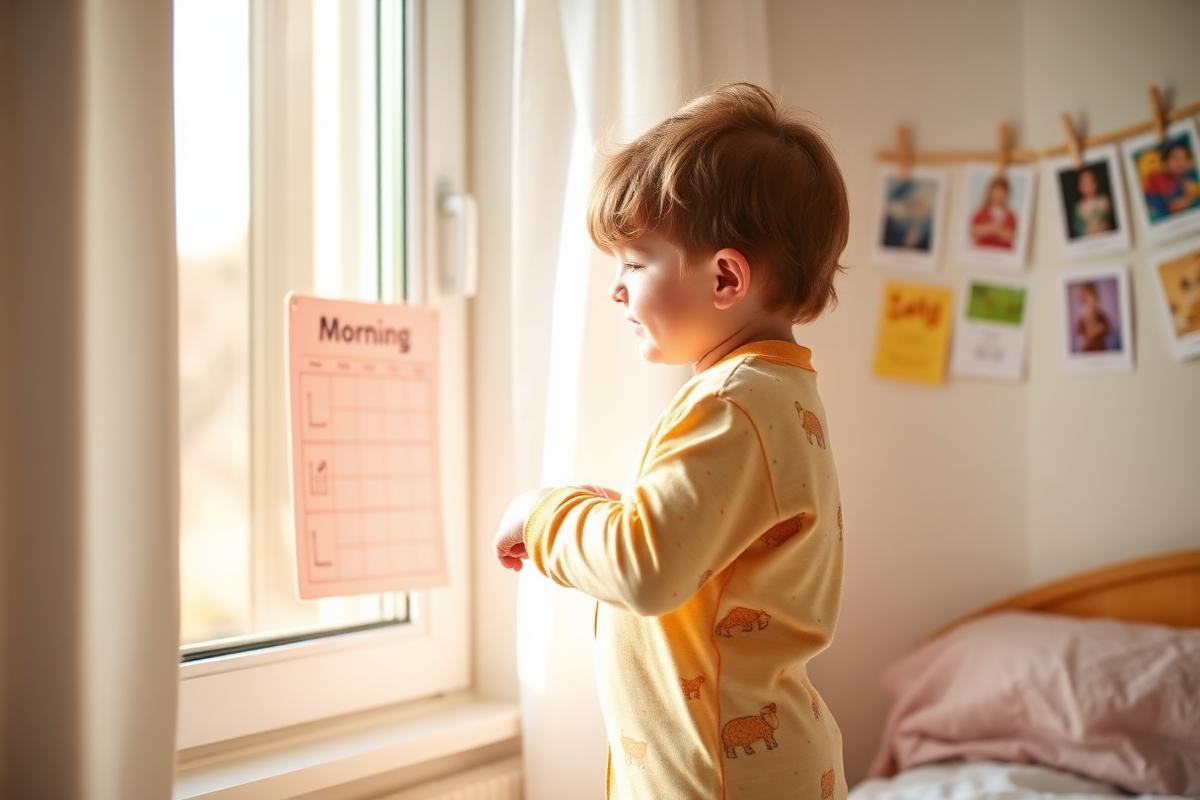
Child getting dressed alone in the morning, next to a visual routine chart taped to the bedroom wall
A visual routine chart at the child's eye level turns the morning into a sequence they can follow themselves.
Why it matters

Why mornings turn into a battlefield

Morning is the time of day when we have the least room for surprises: there's a fixed time to leave the house, and every lost minute turns into pressure. For a child, though, time doesn't work that way — they don't have the same sense of urgency an adult does, and that's exactly where the conflict starts. We're watching the clock; they're absorbed in tying a shoelace for the fifth time.

On top of that, many young children are still in 'slow mode' right after waking up: the brain needs time to come out of deep sleep and become fully alert. Demanding speed at that moment usually produces more tears than results.

The solution isn't waking up earlier indefinitely or raising your voice louder. It's building a morning routine for kids with visible, predictable steps sized to the child's age — so they know what comes next without an adult repeating the same order ten times.

Step by step

How to build the morning routine in 5 steps

Before hanging any chart on the wall, follow this build sequence:

  • List every morning task in the order it happens (wake up, bathroom, get dressed, brush teeth, eat breakfast, put on shoes, grab backpack, leave).
  • Time how long each step actually takes with your specific child — not the ideal time, the real time.
  • Set the 'point of no return' time (the minute you need to be out the door) and work backward from there.
  • Turn the list into simple images — photos, drawings, or icons — for kids who aren't reading fluently yet.
  • Test it for a week, adjust what didn't work, and only then finalize the version on the wall.
By age

Morning routine by age group

An effective morning routine for kids respects what each age can actually do on its own. Use this as a starting point and adjust to your child:

Ages 2-3

At this stage, the child participates but still needs a lot of physical help. The routine chart mostly helps anticipate what's next rather than achieve full independence.

  • 3 to 4 steps at most, with large images
  • Simple choices: 'this outfit or that one?'
  • Estimated total time: 45 to 60 minutes from wake-up to leaving
  • An adult nearby the whole time, guiding calmly

Ages 4-5

They can already follow a 5-to-7-step sequence with visual support and take real pride in doing things 'by themselves.'

  • Chart with 5 to 7 steps in icons or photos
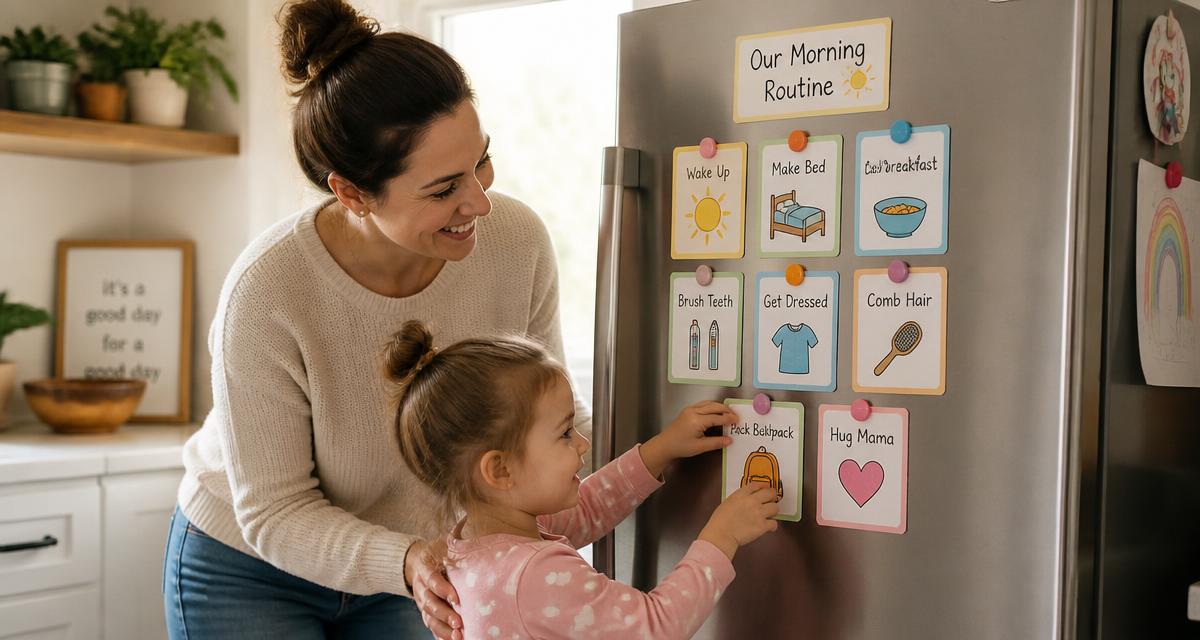
  • Let the child move a magnet or marker after finishing each step
  • Estimated total time: 35 to 45 minutes
  • Specific positive reinforcement: 'you brushed your teeth by yourself today!'

Ages 6-7

The ideal age to introduce a sense of time and greater responsibility, including a clock or visual timer.

  • Chart with 7 to 9 steps, which can include simple words alongside icons
  • Use of a visual timer or hourglass for time-limited steps
  • Estimated total time: 25 to 35 minutes
  • A checklist the child checks off and signs/stamps themselves
The tool

How a visual routine chart works

A well-made school morning routine chart follows a few simple principles that make all the difference in the result:

Child's eye level

Put the chart where the child can reach and see it easily — usually at their eye level, not yours.

Images before words

Real photos of your own child doing each task work better than generic drawings, especially before they read fluently.

Fixed order, always the same

Changing the sequence often cancels out the benefit of predictability. Pick an order and keep it for weeks.

Progress marking

A magnet, sticker, or clip the child moves after each step gives a concrete feeling of progress.

Few, well-defined steps

A short chart the child actually follows is worth more than a long one nobody looks at after day three.

Periodic review

Every few months, review it together with your child: has a step changed, become too easy, or need adjusting?

Common mistakes

The most frequent mistakes when building the routine

A classic mistake is copying another family's routine or a ready-made template from the internet without timing your own child's real pace. If the template allots 5 minutes for getting dressed and your child takes 12, the chart will create frustration instead of helping.

Another mistake is adding too many steps right from the start. It's better to begin with a simplified version, build confidence, and gradually add more steps than to overload the child with a long list from day one.

Finally, many parents abandon the chart after the first two weeks, thinking it 'didn't work,' when in reality internalizing a new routine usually takes three to six weeks of consistent repetition before it becomes a habit.

When they stall

What to do when your child stalls mid-routine

It's normal for a child to simply stop partway through the process on some days — sitting on the floor, playing with a sock instead of putting it on, or crying for no apparent reason. Before anything else, take a breath: yelling or rushing tends to extend the stall, not shorten it.

Point to the chart and ask, without a scolding tone, 'what comes next on our list?' This hands control of the situation back to the child, instead of turning the moment into a direct order from you against their will.

If the stall keeps happening at the same step, that's a valuable clue: it might be a sensorially uncomfortable task (a sock that itches, a toothpaste taste they dislike), a step that's technically hard for their age, or simply the moment when the child is still sleepiest. Adjust that specific step instead of insisting the same way.

And when none of that solves it in the moment, have a backup plan agreed on in advance — for example, getting dressed in the car or taking breakfast wrapped to go. That takes the pressure off the moment without turning the delay into a daily fight.

Checklist

Checklist to build the morning routine this week

This content is informational and does not replace guidance from a healthcare or child development professional. Timings and age ranges are general references — every child has their own pace.

Veja também

Keep exploring

Tools and reads from momsnet to organize your family's routine.

More reading on the same topics.

Child having a healthy breakfast in a sunlit family kitchen
Routine7 min read

Routines that work: predictability done lightly

Routines give kids security. Learn how to build one without rigidity or guilt.

#routine#sleep#organization
Read article →
Father reading a picture book to a child in bed under a soft bedside lamp
Sleep8 min read

Bedtime routine for kids: the complete guide to tear-free sleep

A 30-45 minute wind-down sequence, sleep hours by age, screens before bed, bedtime resistance and night waking.

#sleep#routine#bedtime
Read article →
Open colorful insulated lunchbox with fruit, a muffin, a butterfly-shaped sandwich, cheese cubes and a water bottle
Nutrition7 min read

Stress-free school lunchbox: the best ideas for lunches that come home empty

A simple formula, Sunday prep, food safety in hot weather and ideas for healthy school lunches kids actually eat.

#school lunchbox#healthy eating#school
Read article →
Mother lovingly helping her son with homework at a sunlit study table
Education20 min read

My child is struggling at school — how to help at home

An honest, evidence-based guide: warning signs, support at home, study routine, talking with the school and when to seek professional evaluation.

#school#learning#routine
Read article →
Young child sleeping peacefully in bed with a plush toy
Routine7 min read

Sleep and development: how many hours your child really needs

Sleep hours by age (0–8), signs of not sleeping enough, a four-step bedtime routine and what to do about night wakings.

#routine#sleep#0 to 8 years
Read article →
Child with a backpack waving goodbye to a parent at the school door
Routine6 min read

Back to school without the stress: 9 tips that help

Sleep, routine, a short goodbye ritual and reconnection time — a lighter back-to-school for everyone.

#back to school#routine#school adjustment
Read article →
Toddler touching her newborn sibling's hand beside their mother
Routine7 min read

New sibling: how to prepare your child for the new baby

Jealousy, regressions and adjustment: 12 practical ways to prepare the older sibling before, during and after the birth.

#routine#siblings#jealousy
Read article →
Mother and young child planning the week's menu in the kitchen with jars of prepped fruit and vegetables
Food8 min read

Weekly meal planning for families with young kids

A 30-minute Sunday method: a base of 10 accepted recipes, a shopping list, batch prep and using up the pantry.

#food#meal planning#recipes
Read article →
See all articles →

Receba atividades novas toda semana.

Sem spam. Só ideias boas para você e seu pequeno.