
Rhymes, songs and stories: playful traditions that help your child talk better
If your child came home from school singing a silly song or repeating a tongue twister, take the hint. Traditional rhymes, songs, tongue twisters and folk tales aren't just fun — for generations, they were the natural "speech therapy" of families everywhere: repetition, rhythm, rhyme and storytelling, all wrapped up in play. In this post, we take a tour through classic rhymes and folk tales — including some well-loved Brazilian ones — and show, in practice, how to turn this playful tradition into speech and vocabulary stimulation for every age.
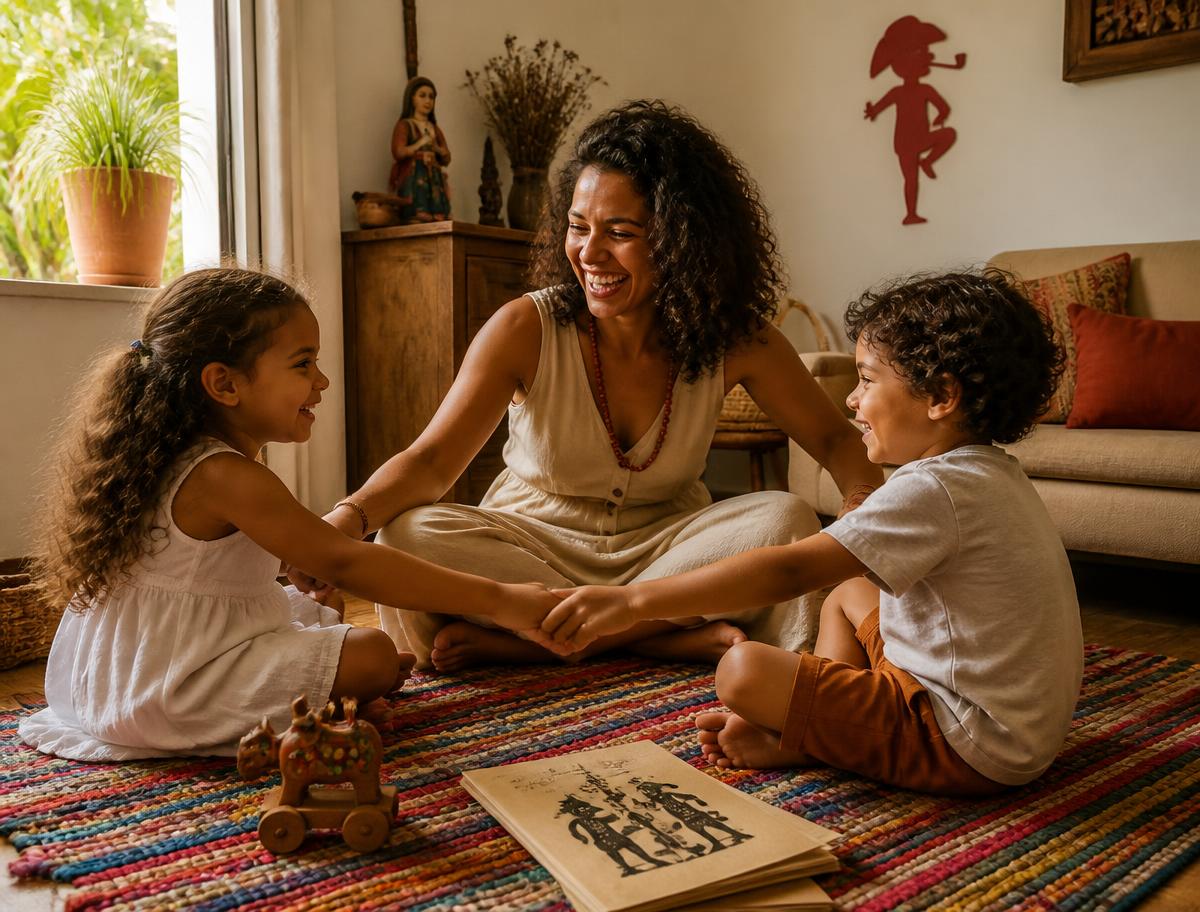
Why are rhymes and folk tales so good for language?
Long before any "educational" app existed, children learned to talk by singing circle songs and playing rhyming games. And it makes perfect sense: developmental science shows that language grows through repetition, musicality and human interaction — exactly the ingredients found in rhymes and folk traditions. Circle songs feature predictable sound patterns that train phonological awareness (the ability to notice the sounds that make up words, a foundation for later literacy). Tongue twisters are articulation gymnastics: they exercise lips, tongue and cheeks on the trickiest sounds in the language. Nursery rhymes and chants build memory and sequencing. And folk tales develop what experts call oral narrative — the ability to tell a story with a beginning, middle and end, one of the best predictors of later reading and writing skills.
Even better: all of this happens face to face, eye to eye, with laughter and affection — a combo no screen can replace.
Classic rhymes and songs from around the world
Every culture has its own treasury of rhymes, and English has plenty of gems: "Row, Row, Row Your Boat," "Twinkle, Twinkle, Little Star," "Hickory Dickory Dock" and "Itsy Bitsy Spider" all use repetition and rhythm to help little ones map the sounds of language. Brazilian families grow up with their own equally beloved versions — songs like "Ciranda Cirandinha" (a gentle circle song about a wedding ring) or "Atirei o Pau no Gato" (a playful, silly tune about a cat, now often sung in a kinder "don't throw things at the cat" version). Trading rhymes across cultures is itself a lovely language activity: ask a grandparent or a friend from another country to teach your child a rhyme from their childhood.
Tongue twisters: a workout for tricky sounds
"She sells seashells by the seashore," "Peter Piper picked a peck of pickled peppers," "How much wood would a woodchuck chuck" — English tongue twisters are famous for a reason. Brazilian Portuguese has its own classics, like "O rato roeu a roupa do rei de Roma" ("the mouse gnawed the king of Rome's clothes") and "O sabiá não sabia que o sábio sabia assobiar" ("the songbird didn't know the wise man knew how to whistle") — fun to try even without understanding every word, just for the sound play. Start slow, stumble together, and laugh a lot; the mistakes are half the fun and take all the pressure off. Tongue twisters are especially useful for kids who still swap sounds like "r" and "l," because they exercise articulation without ever feeling like a drill.
Folk tales: legends that spark storytelling
Every region has its own cast of legendary characters, and they're a goldmine for language. In Brazil, children grow up with the Curupira, a forest guardian whose feet point backward to confuse hunters trying to harm the woods — ask your child to explain, in their own words, why the backward feet trick people, a great exercise in verbal reasoning. There's the Saci, a one-legged, red-capped trickster who's mischievous but good-hearted underneath, perfect for inventing new pranks together ("what did the Saci get up to in our kitchen today?"). And the Boitatá, a fire-snake said to protect the fields, rounds out a whole cast of nature guardians. English-speaking traditions have their own storytelling gems too — think of Paul Bunyan and his giant blue ox, or Johnny Appleseed wandering the countryside planting orchards. Researching a lesser-known legend together and retelling it to the rest of the family puts your child in the role of storyteller, one of the best narrative workouts there is.
Babies and toddlers up to age 3: the power of the circle song
At this stage, songs are gold: "Row, Row, Row Your Boat," "The Wheels on the Bus," "Twinkle, Twinkle, Little Star," "Itsy Bitsy Spider." Sing while holding them, with gestures, repeating over and over — the repetition that tires adults out is exactly what a baby's brain needs to map the sounds of language. Pause before the last word and wait: "Twinkle, twinkle, little..." — that half-second pause invites your child to fill in the blank, and that's exactly how speech gets built.
Ages 3 to 5: chants and riddles
"One, two, buckle my shoe," "Eeny, meeny, miny, moe," "Rock, paper, scissors" chants — these little rhymes teach sequencing, memory and rhythm, and double as a fair way to decide who goes first in a game. Riddles ("what am I?") are a delightful workout for verbal reasoning: start easy ("I have a crown but I'm not a king, I have spikes but I'm not a fish" — a pineapple!) and let your child make up their own, even if they don't quite make sense. They make plenty of sense for language, and that's what matters.
Age 5 and up: tongue twisters and retelling
Now it's time for a real challenge: "She sells seashells by the seashore," "Peter Piper picked a peck of pickled peppers," "Fuzzy Wuzzy was a bear." Start slow, stumble together, laugh a lot — mistakes are part of the fun and take the pressure off. And this is the age when retelling really shines: after telling a folk tale, ask your child to tell it back to the other parent, to a grandparent on a video call, or to their stuffed animals. Retelling a story in their own words locks in vocabulary and narrative structure.
A word about scary legends
Not every child is ready for a headless ghost galloping in flames — and that's fine. Folklore has always been adapted to its audience: choose the gentle versions for younger kids (a mischievous trickster, a protective forest spirit, a helpful bird) and save the spookier tales for when your child asks for them — often around age 7 or 8, when a little shiver becomes part of the fun. If a story does scare them, comfort them, explain that it's a story people made up long ago, and go back to the friendlier legends. The goal is to delight, never to frighten.
The best folklore lives in your own family
To wrap up: the most valuable activity this week doesn't need a printer or any planning at all. Ask grandparents which stories and songs they heard as children — and let your child interview them. Every family keeps its own folklore, with an accent and details you won't find in any book. That bridge between generations is language, memory and affection all wrapped into one game. And that's exactly how these traditions have crossed generations, mouth to mouth, all the way to your child.
Happy storytelling! And if the milk spills in the kitchen tomorrow... well, you already know who to blame. 💜
Play today
- Sing a circle song, pausing before the last word so your child can fill it in.
- Pick a chant or rhyme to use for deciding who goes first in a game.
- Tell a gentle folk tale (a friendly trickster or forest guardian) and ask for a retelling afterward.
- Practice a tongue twister slowly, laughing at the mistakes together.
- Read a rhyming poem out loud, exaggerating the rhythm and rhyme.
- Call the grandparents and let your child interview them about the songs and stories from their childhood.
This content is informational and does not replace an evaluation by a speech-language pathologist or pediatrician. If you have concerns about your child's speech, seek professional guidance.
Keep exploring
More content on language, play and routines that support development.
Language development
Speech milestones and how to encourage everyday conversation.
Ver mais →Free play vs. structured play
How to balance both types of play in your routine.
Ver mais →Printable literacy activities
Free materials by age for play-based learning.
Ver mais →All articles
Guides on development, routines and family life.
Ver mais →Related posts
More reading on the same topics.
Free play vs structured activities: finding the right balance
Why boredom isn't the enemy, what each kind of play teaches, and how to balance the week by age (1–8).

Language development: when to worry and how to encourage speech
What to expect at each age, the signs worth checking, and 6 simple everyday ways to encourage speech (ages 0–5).
Little puzzles, big minds: why logical thinking matters in childhood
Play, conversations and household chores: simple ways to help kids compare, predict, explain and solve problems.
Developmental milestones by age: the 0–6 year guide
Motor, language, cognitive and social milestones stage by stage — with clear red flags and what to do at home, no comparisons.
Social development: how kids learn to share, wait and make friends
Why sharing only clicks after age 3, how to mediate conflict without playing judge, and what to do about shyness and biting — ages 1 to 7.
Fine motor skills: everyday activities that prepare the hand to write
Age-by-age activities (1–6) and everyday tasks that build hand strength long before the notebook.
Social-emotional skills at home: raising kids who can name what they feel
The five social-emotional competencies, seven simple daily habits and the free momsnet tools to practise today.

50 rainy day activities for kids with no screens (do them at home today)
Movement, art, pretend play, cooking and calm-down ideas: 50 rainy day activities by age, using what you already have at home.
Receba atividades novas toda semana.
Sem spam. Só ideias boas para você e seu pequeno.