Learning · toys · 7 min

The best STEM toys on Amazon to spark curiosity in little ones.

STEM toys (Science, Technology, Engineering and Mathematics) turn play into hands-on learning — without feeling like homework. Below, a pick organised by age and area of interest.

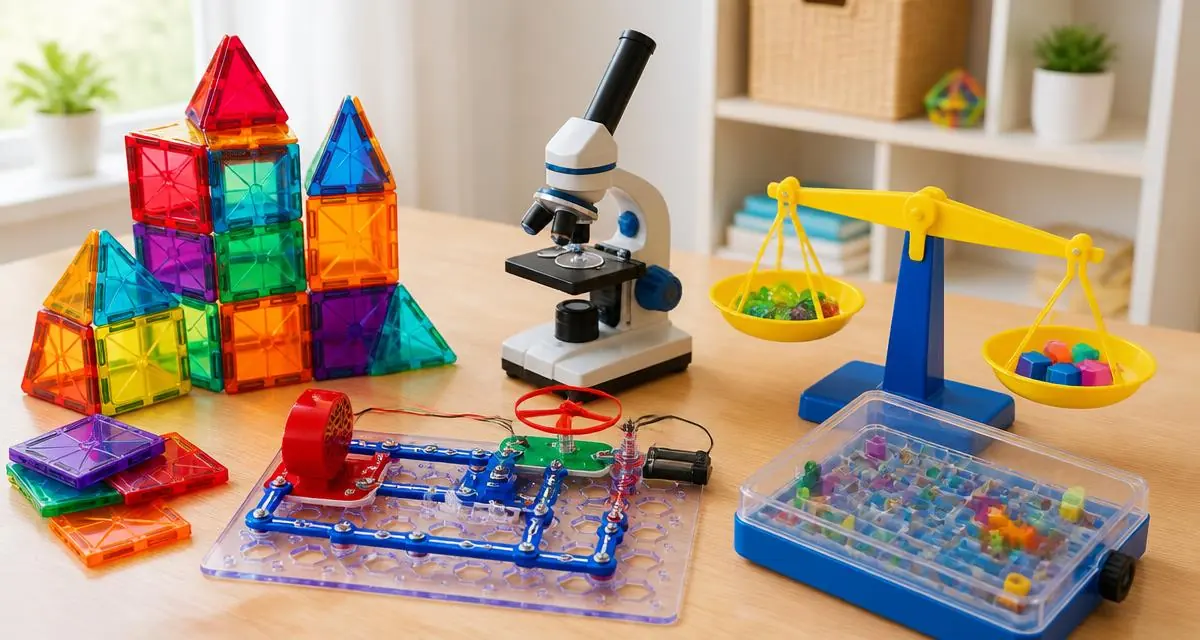
STEM toys on a table: magnetic tiles, kids' microscope, circuit kit, balance scale and a logic game
Buying tip

Choose by the child's real interest.

Pick based on your child's current interest, not the interest you wish she had. A child who loves building will engage far more with an engineering kit than with a chemistry set she never asked for.

🧲 Little explorers3–6 years

For the little explorers.

At this stage the point is free handling: clipping, weighing, observing. Open-ended toys last far longer than step-by-step kits.

🔷

Magnetic building tiles (Magna-Tiles style)

Translucent magnetic tiles that snap together into towers, houses and all kinds of shapes. One of the rare toys that gets used for years, because the builds grow in complexity along with the child.

See it on Amazon →


⚖️

Balance scale to introduce weight

Toys like Hape's little-monster balance scale introduce the idea of weight to young children, usually from ages 3 to 5, often with difficulty levels that follow their development.

See it on Amazon →
🔬

Beginner kids' microscope kit

Beginner models come with prepared slides, so the child can start observing right away with no setup — a great first taste of scientific investigation.

See it on Amazon →
🔧 Builders and the curious6–9 years

For the builders and the curious.

This is where cause and effect kicks in: build something and watch it happen. Kits with several projects hold interest for much longer.

💡

Snap-together circuit kit (Snap Circuits Jr. style)

One of the kits educators most often recommend for this age: pieces snap together with no soldering and no programming, and the effect is immediate — the child builds the circuit and sees the light come on or the motor spin. It works precisely because cause and effect shows up instantly, which keeps attention far longer than passive toys.

See it on Amazon →
🚀

Water rocket kit

A classic slice of applied physics: kids learn about propulsion and air pressure by building and launching their own rocket. Usually just as fun for the grown-ups taking part, with extra appeal for space and astronomy fans.

See it on Amazon →
🌀

Gravity-maze logic game

Logic games with pieces that steer a marble to a target (Gravity Maze style) build spatial thinking and planning, and work beautifully as a quiet solo activity.

See it on Amazon →
💻 Future coders7–12 years

For the future coders.

Coding logic and slightly more serious electronics — ideal for kids who already show steady interest in building and testing.

🧩

Coding kit with physical blocks

Kits that teach coding logic through physical blocks or cards (no screen needed until the very end) are a great entry point before moving on to screens and apps.

See it on Amazon →
🔌

Advanced circuit kit

For kids who already have the electronics basics down, more advanced circuit kits (more parts, more projects) pave the way for deeper STEM classes and electronics hobbies later on.

See it on Amazon →
🤖

Programmable robotics (LEGO Mindstorms style)

For kids with a consistent interest in building and tech, programmable robotics kits let them literally build and program a robot — a bigger investment, with big long-term use potential.

See it on Amazon →
📚 Books

Books that round out the play.

Illustrated books about science and space are worth considering alongside the toys.

🪐

Illustrated astronomy book for kids

A good astronomy book with plenty of imagery is usually among the category bestsellers and holds the attention of even young children.

See it on Amazon →
🔭

Science book for curious minds

The perfect companion to the kits: it explains, in simple terms, the “why” behind what the child just built or observed.

See it on Amazon →

How to choose: questions to ask before buying.

Has my child lost interest in similar toys quickly before?

If so, favour kits with multiple projects or difficulty levels, so the interest doesn't run out in a week.

Does he prefer following instructions or inventing his own way?

Step-by-step manual kits (like snap circuits) suit instruction followers; open-ended blocks (like magnetic tiles) suit free creators.

Will this be a solo or a family activity?

Launch kits (like water rockets) are usually far more fun as a shared activity.

✅ Quick checklist by age.

3–6 years

magnetic tiles, balance scale, beginner microscope

6–9 years

basic circuit kit, water rocket, logic game

7–12 years

physical coding kit, advanced circuits, programmable robotics

Frequently asked questions.

What are STEM toys?

STEM stands for Science, Technology, Engineering and Mathematics. STEM toys turn play into hands-on learning — the child builds, tests and observes results without it feeling like homework.

What is the best STEM toy for a 3-year-old?

At this age, open-ended, easy-to-handle toys work best: magnetic building tiles and balance scales that introduce the idea of weight.

How do I choose a STEM toy my child will actually use?

Choose based on her current interest, not the interest you wish she had. A child who loves building will engage far more with an engineering kit than with a chemistry set she never asked for.

What age can coding start at?

Coding kits with physical blocks or cards work well from around age 7, because they teach sequencing logic before any screen is involved.

Prices and availability on Amazon change often — it's worth checking the product page before buying. This content is informational and is not individualised medical or educational advice. The Amazon links are affiliate links: momsnet may earn a small commission on qualifying purchases, at no extra cost to you.

See also

Keep exploring

Keep exploring topics that connect with this content.

See also

More STEM activities on momsnet

Keep the curiosity going with maths, science and technology — all free.

More reading on the same topics.

Mother lovingly helping her son with homework at a sunlit study table
Education20 min read

My child is struggling at school — how to help at home

An honest, evidence-based guide: warning signs, support at home, study routine, talking with the school and when to seek professional evaluation.

#school#learning#routine
Read article →
Parent and child reading a book together at home, a warm learning moment
Development12 min read

Stages of learning: from baby to teenager

Every age brings predictable milestones and new ways of learning. A guide to support each stage with love.

#learning#milestones#age
Read article →
Child arranging a funny face on a plate with broccoli, carrots and blueberries
Food7 min read

Picky eating: 10 games to help your child try new foods

No battles at the table: games at home, in the kitchen and at the shops to widen the menu for ages 2–8.

#food#picky eating#games
Read article →
Two children playing freely with wooden blocks and a blanket fort
Development6 min read

Free play vs structured activities: finding the right balance

Why boredom isn't the enemy, what each kind of play teaches, and how to balance the week by age (1–8).

#development#play#routine
Read article →
Child's hands threading colourful beads onto a string
Development6 min read

Fine motor skills: everyday activities that prepare the hand to write

Age-by-age activities (1–6) and everyday tasks that build hand strength long before the notebook.

#development#fine motor skills#writing
Read article →
Mother and son reading an illustrated book together at the table
Literacy8 min read

Reading comprehension in 1st grade

How to support reading comprehension in 1st grade with the right questions, short texts and easy activities.

#reading comprehension#reading#1st grade
Read article →
Happy child doing literacy activities with letter cards
Literacy9 min read

12 printable literacy activities

By stage and goal: tracing, syllables, reading and more — simple, playful ideas for home and school.

#literacy#printable#letters
Read article →
Smiling 6-year-old doing a printable educational activity
Activities8 min read

Printable educational activities for 6-year-olds

Practical ideas by skill — literacy, math, coordination and attention — easy to apply at home.

#activities#printable#6 years
Read article →
See all articles →

Get new activities every week.

No spam. Just good ideas for you and your little one.